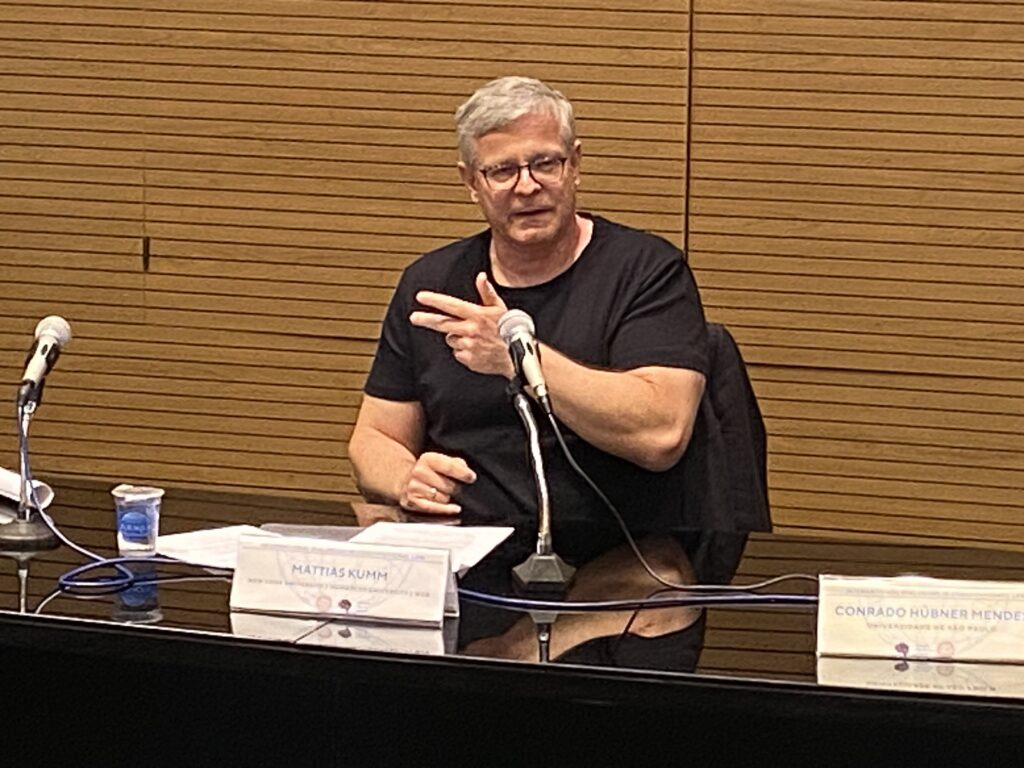
Mattias Kumm: Regulation of Digital Platforms

One of the issues that most concerns contemporary democracies is the role that digital platforms and their algorithmic models have played in spreading misinformation and fueling polarization and hatred. They have influenced elections and provided a powerful tool for extremism. Government regulation of these companies has become a top priority on the agenda for defending democracy.

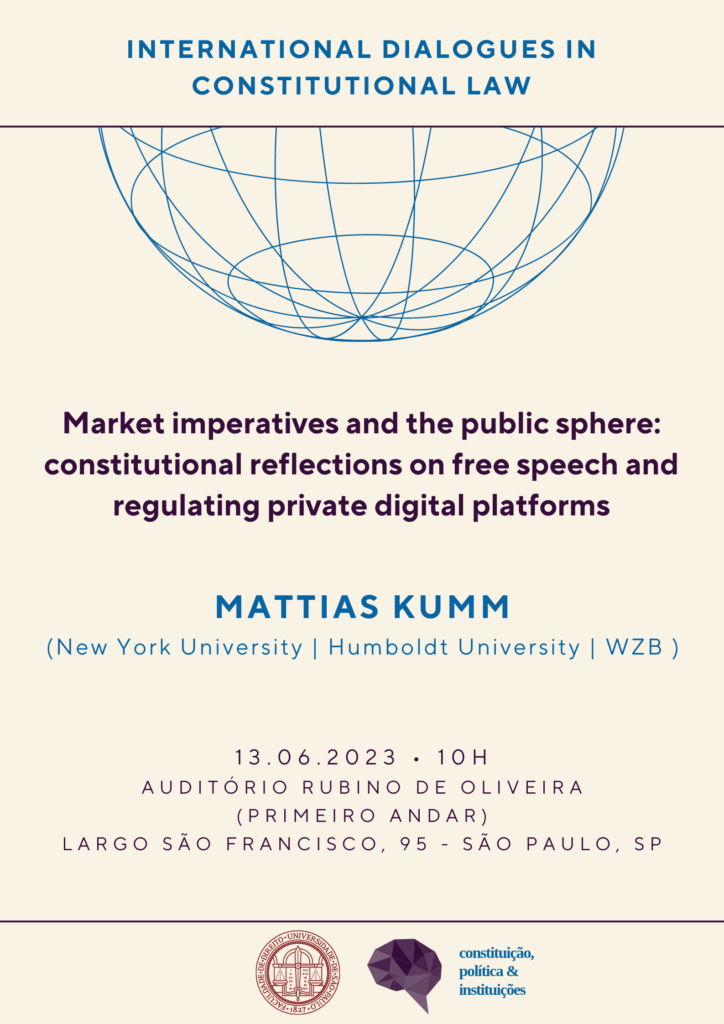
In his lecture as part of the International Dialogues in Constitutional Law series, Mattias Kumm, of New York University (NYU) and Humboldt University of Berlin, discussed how to address the challenge of regulating these platforms in light of the values of global constitutionalism.
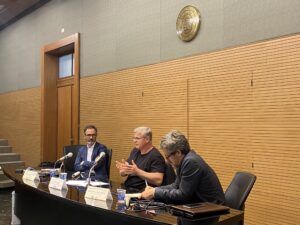
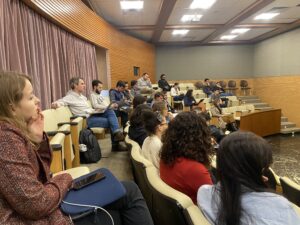
Market Imperatives and the public sphere: Constitutional Reflections on free speech and regulating private digital platforms
MATTIAS KUMM
New York University (NYU) and Humboldt University Berlin
13 June, 10h00
Largo de São Francisco, 95. Historical Building, Rubino de Oliveira Auditorium
 

Virgílio Afonso da Silva participates in multidisciplinary event on covid-19

Yesterday, December 14, an event featuring experts from a wide range of fields was held by the Office of the Dean of Graduate Studies at the University of São Paulo. Faculty members from the fields of medicine, economics, biosciences, engineering, and law presented their respective fields’ perspectives on addressing the COVID-19 pandemic.

More information (including the full video of the event) can be found in the Jornal da USP site.

International Dialogues: Judge Susanne Baer asks “who protects your fundamental rights?”

On 14 November 2018, Justice Baer, who serves at the German Federal Constitutional Court as a Justice of the First Senate, discussed the status and value of constitutional law in a world in which societies face a multitude of challenges. All of us, as well as courts need to react properly to fast economic, social and cultural change that affects everyone´s lives. (more…)

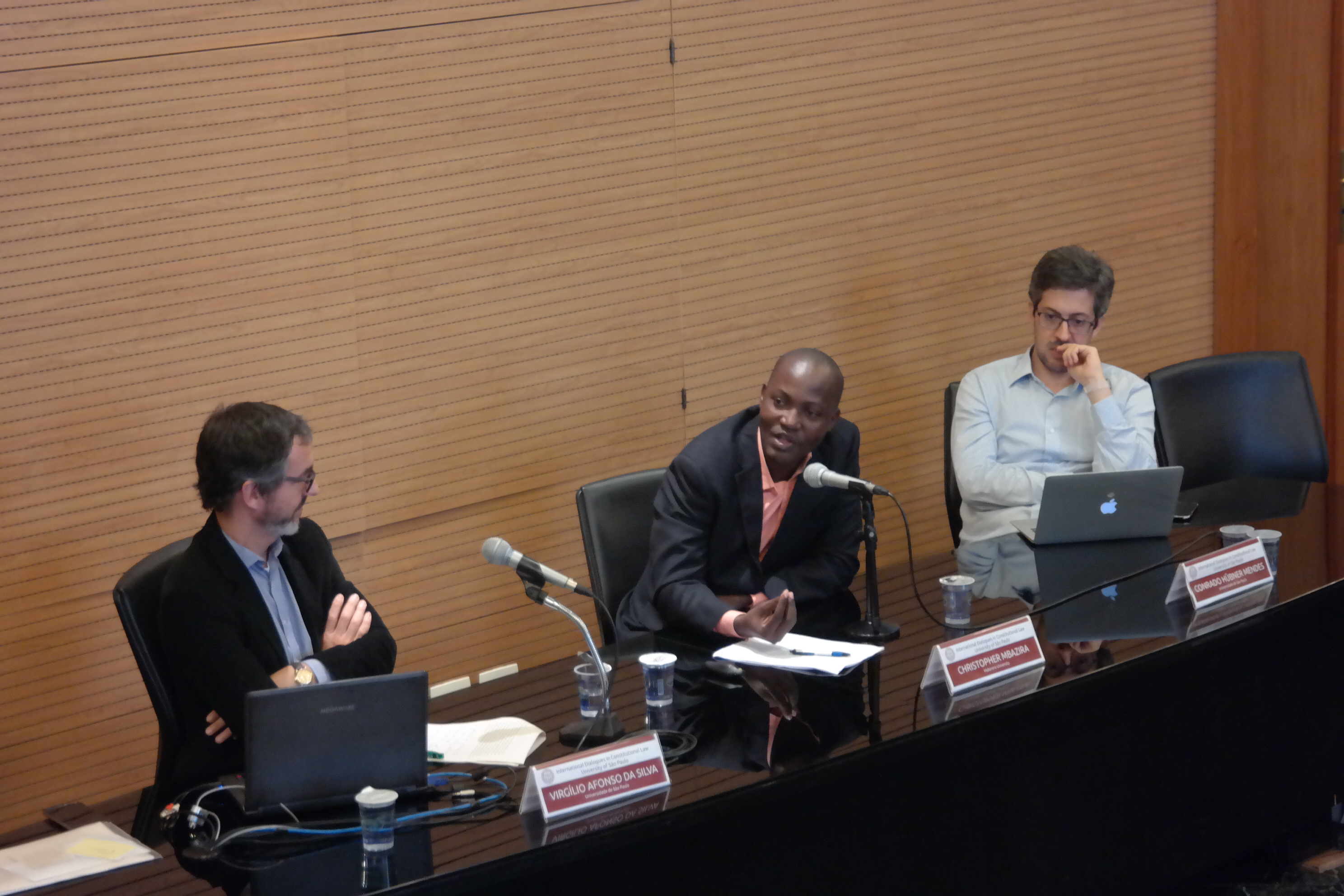
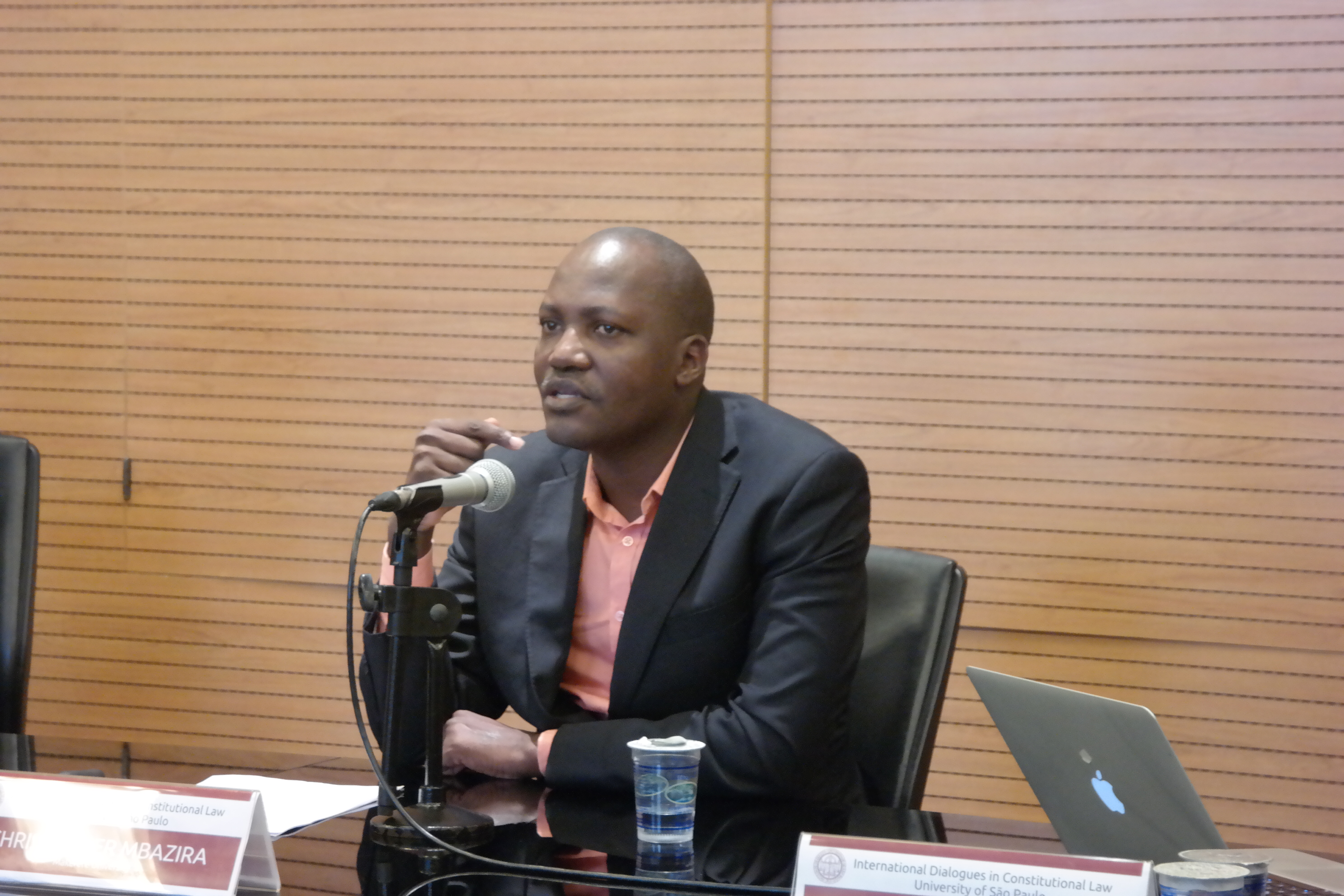
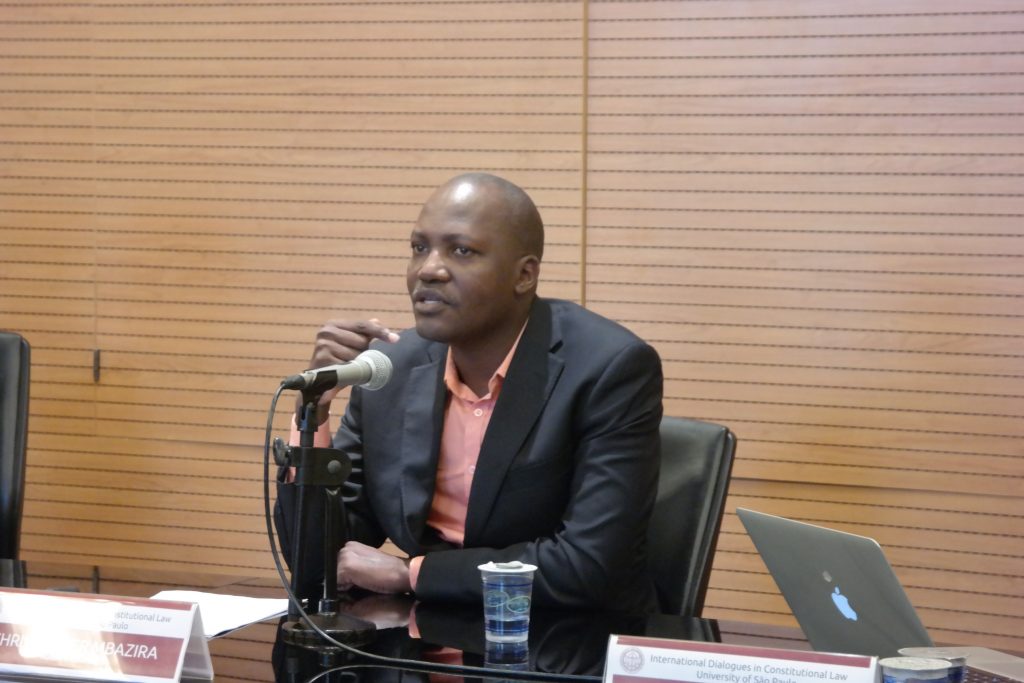
Christopher Mbazira (Makerere University, Uganda): Transnational judicial dialogues and the enforcement of socioeconomic rights

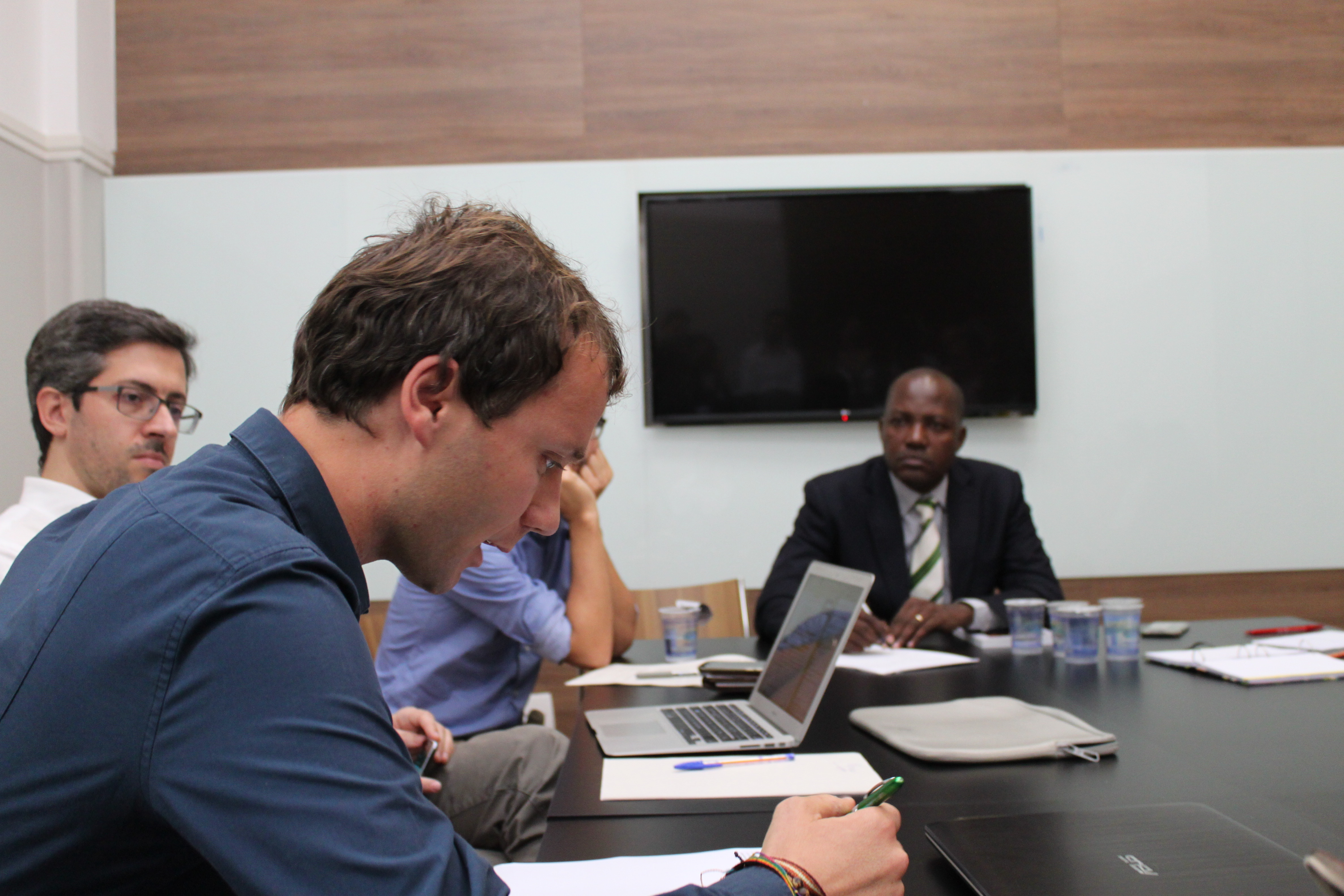
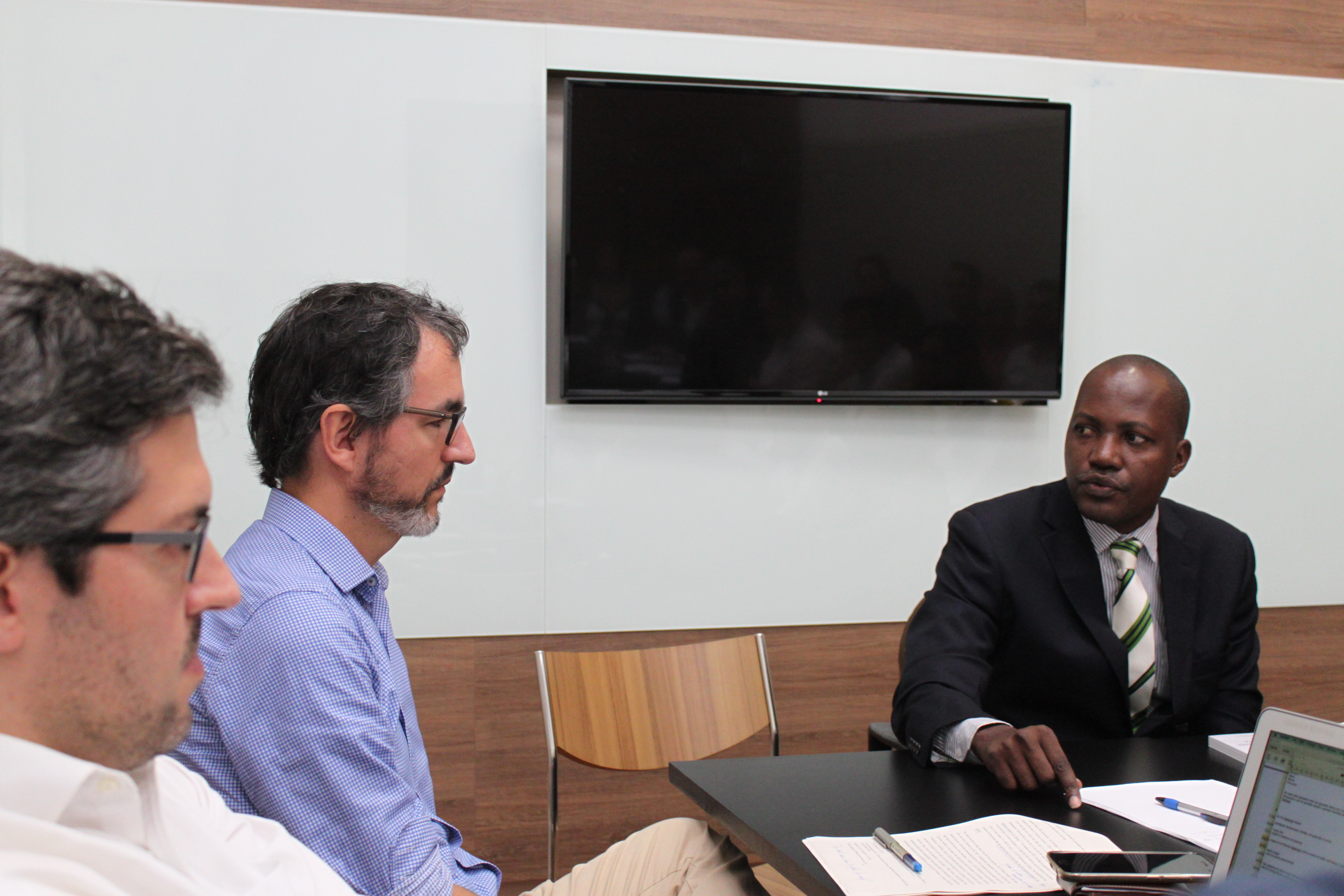
On October 17, 2018, our guest was Prof. Dr. Christopher Mbazira, professor at Makerere University in Uganda. From the analysis of constitutional jurisdiction and constitutionalism in three African countries (South Africa, Kenya and Uganda), Mbazira identifies the existence of a transnational judicial dialogue. This dialogue is mainly expressed by direct interaction between judges from different countries which voluntary quote votes from other Courts.

Mbazira argues that the best explanation for this phenomenon is that judges have progressively increased the amount of times foreign Court’s decisions are quoted because they identify themselves as peers. Thus, organically, they have come to recognize similarities in the agenda pursued, in the methods used and in the purposes sought by the institutional structure in which they belong.

To illustrate this relationship, he presented a set of concrete examples. In this movement, South Africa emerges as the Country leading the changes and inspiring other countries to emulate them, as a leader of the pack. However, in recent times, Kenya has also emerged as a possible influence for other Courts in advancing rights. This was mainly due to the adoption of the new constitutional text, also influenced by other Countries. Among other provisions, this constitution establishes that State must prove the absence of financial resources to finance public policies.

After professor’s Mbazira’s presentation, he answered questions presented by the audience, among which (i) about the possibility of naming the phenomenon as dialogue if no actual exchanges between Courts occur, (ii) related to the evidence of the existence an effective influence, and (iii) resulted in an invitation to conduct a normative reflection on the consequences of this phenomenon.

Written by Ana Laura Pereira Barbosa. Translation by Natalia Langenegger. Photos by Artur Pericles Lima Monteiro and Fernanda Mascarenhas de Souza.

Anthony Pereira (King’s College London): Progress or Perdition? Brazil’s National Truth Comission in Comparative Perspective

In the second meeting of the International Dialogues in Constitutional Law series in 2017, held on May 17, Anthony Pereira (King’s College London) presented his lecture entitled Progress or Perdition? Brazil’s National Truth Commission in Comparative Perspective.

Pereira presented the main reasons that led him to write about transitional justice in Brazil. In particular, he focused on two reasons: the first is that transitional justice in Brazil began long after the key events of the authoritarian period, especially if compared to other Latin American countries; and, second, the apparent inaccuracy of the official data on violence during the authoritarian period: unlike the case in other Latin American countries, the data shows that violence is much higher now than during the authoritarian regime.

Pereira also discussed the lessons he learned after analyzing the transitional justice in Brazil. He argued that in order to effectively understand the results produced by the Truth Commission, it is necessary to fully understand its institutional context. Moreover, he argued that transitional justice should be analyzed from an interdisciplinary perspective, not only from the perspective of the social sciences, but also from a normative and ethical perspective.

Roberto Gargarella (University of Buenos Aires): The New Latin-American Constitutionalism: a too old constitutionalism?

In the first meeting of the International Dialogues in Constitutional Law series in 2017, on April 19, our guest was Roberto Gargarella, from the University of Buenos Aires (UBA).

In his lecture, Gargarella presented the reasons why, in his view, the new Latin American constitutionalism has not been able to respond effectively to contemporary challenges.

According to Gargarella, the main function of constitutionalism is to cope with the dramas of its time. The first constitutions of Latin America attempted to respond to the question of how to organize power.

The contemporary Latin American constitutions face a distinct challenge: the massive violations of human rights by the Latin American states. To this end, the adopted strategy has been the accumulation of declarations of rights, many of them with conflicting goals: classical liberal rights, social rights, transindividual rights and rights provided for in international human rights treaties.

One major problem with this strategy lies in the fact that it does not affect power structures, and this undermines the enforcement of rights.

Ralf Poscher (Universität Freiburg, Germany): Codifying the right of assembly

Our International Dialogues on Constitutional Law hosted Ralf Poscher (Universität Freiburg). He talked about freedom of assembly, drawing from his experience in devising a ‘master code’ for freedom of assembly in Germany.
Poscher started his talk by emphasising what he thinks is the central aspect of the freedom of assembly, the physical presence of demonstrators, who ‘stand with their bodies’ for the ideas they advocate, he said. This makes protests a special kind of expression, different from writing an op-ed piece for a newspaper, for instance. It is precisely because a demonstrator’s body is exposed that he is afforded the special protection of the freedom of assembly.
Regulation must have this aspect above all, Poscher argued: while some restrictions required to prevent harm should be admitted, those are second-level concerns. The primary goal of regulation should be to “enable and facilitate the exercise of the right of assembly”.
Law should then respect the autonomy of the assembly: organisers should be free to pick the purpose, the time, the route and generally how to organise it. The master code consequently admits assemblies that have no leaders or formal organisation even, although it does provide for a kind of assembly which is directed by a leader, who is given power to take decisions which are legally binding upon demonstrators. The police, in that case, are only allowed to interfere with the assembly after calling upon the leader of the assembly to address an issue (by removing a demonstrator engaging in disorderly conduct, for instance) by themselves.
The master code also includes a mandante that organisers give the police 48h notice of the assembly, or face a misdemeanour charge. This is mitigated for spontaneous assemblies and assemblies called with less than 48h before the time of the assembly.
The police are only allowed to interfere with the assembly when there is a ‘imminent, concrete risk to public safety’, Poscher explained. This means that abstract speculations and even concrete risk of minor illegal behaviour do not sanction police interference. And the police are only allowed to disband an assembly when it deems there is no alternative to preventing harm. Only following this formal decision by the police, and after demonstrators are warned and given appropriate notice, are then the police allowed the proceed under ‘regular police law’.
Demonstrators are also generally entitled to wear masks and protective gear. Those might be needed so that individuals are able to exercise their freedom of assembly, wearing masks to avoid retaliation for joining a protest, and protective gear to protect against those who would explore their bodily exposition to harm them. Conceding that those may also be use to facilitate illegal conduct, the master code provides that the police may order demonstrators to remove those, again in a formal decision which may be challenged in court afterwards.
Similar rules apply to assemblies in privately-held public places: if those are used for transit as streets and parks are, demonstrators are not required to secure consent of the owner.
Poscher finally highlighted that while those provisions are all important in preserving freedom of assembly, a democratic culture in policing is just as important; police, he insisted, must have a clear view of their professional responsibility to enable and facilitate assemblies, instead of limiting or managing them.